How to Play Tongits
Tongits is a three-player rummy game from the Philippines. You are dealt a hand, you build melds, and you try to be the one holding the least worthless cards when the hand ends. This page explains all of it, with pictures. If you would rather learn by doing, the interactive tutorial walks you through a real hand in about two minutes.
The Short Version
- Players: three, using one standard 52 card deck with no jokers.
- Goal: empty your hand for an instant Tongits win, or hold the lowest deadwood when the hand ends.
- Deadwood: the total value of the cards you never melded. Ace counts 1, face cards count 10, everything else counts its face value.
- Melds: a set is three or four cards of the same rank. A run is three or more consecutive cards in one suit.
- The hand ends when someone goes Tongits, the deck runs out, or a Fight is called and settled.
A Short History
Tongits is genuinely young for a card game, and its origin is not settled. What the reliable references agree on is modest: it is a three player knock rummy that became popular in the northern Philippines in the late twentieth century, and it is played with a single 52 card deck.
Pagat, John McLeod's long running card game reference, describes Tongits as appearing in the late twentieth century and notes that both the name and the structure of the game suggest a relationship to the American game Tonk, of which it looks like an extended version played with twelve card hands.
Wikipedia records that the game gained popularity in the 1990s in Luzon, that it is known as Tung-it in Pangasinan, and that it was evolved and popularised among Ilocanos.
A note on the origin story. You will often read that Tongits was brought to the Philippines by American military personnel in the 1940s. That specific claim is tagged citation needed on Wikipedia itself, and the sites that repeat it as settled fact do not cite anything either. The honest position is that the Tonk resemblance is real and well observed, while the route by which it arrived is not documented.
The Table
Three players, thirteen cards to the dealer and twelve to everyone else. The dealer goes first. Down the left are the draw pile and the discard pile, and the wide area in the middle is where melds go once they are exposed.
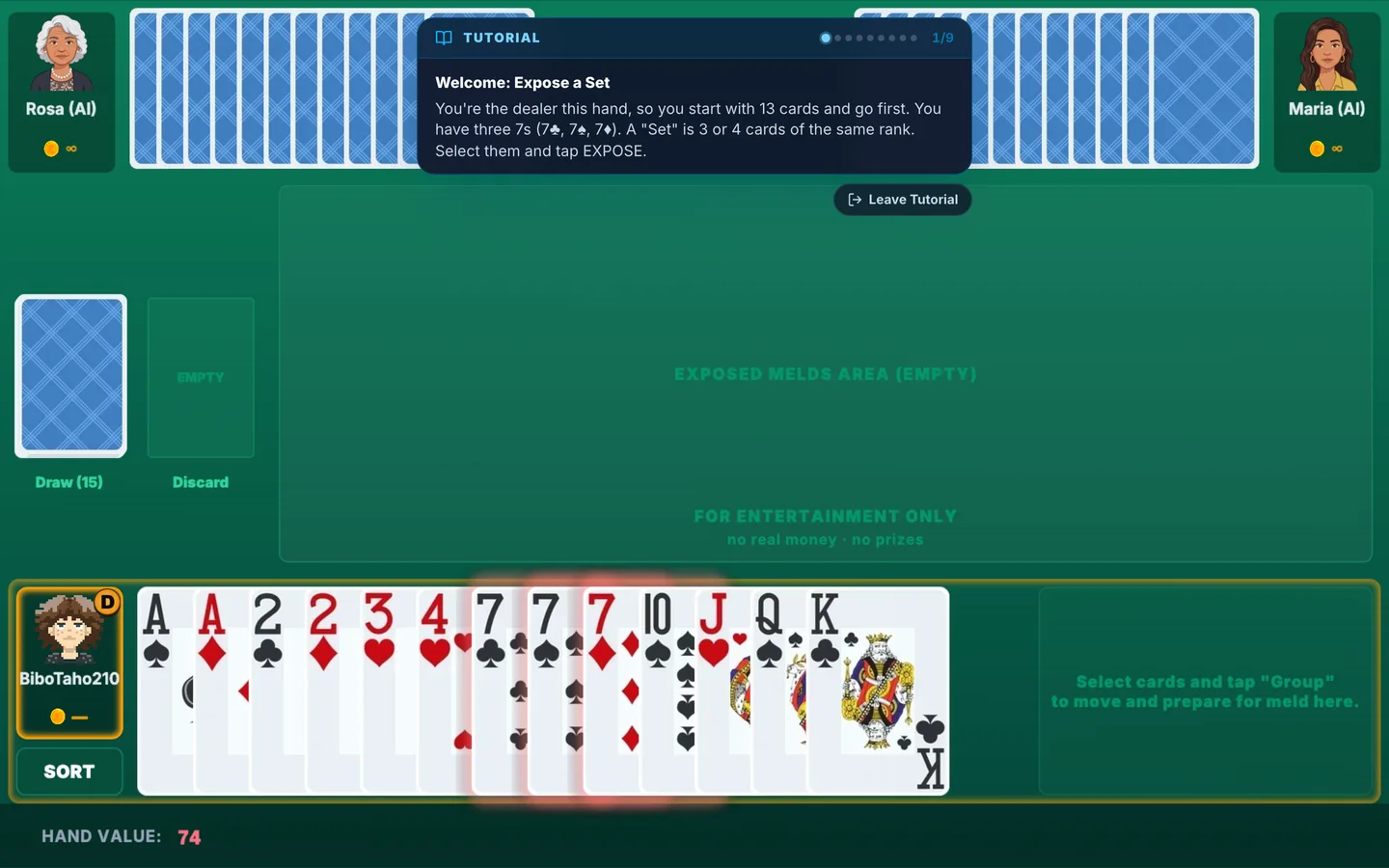
Your hand value sits under your cards. That is your deadwood if the hand ended right now, so watching it fall is the simplest way to tell whether a turn helped you.
Your Turn, Step by Step
1. Take a card
Draw the top card of the deck, or take the card the previous player just discarded if you can use it immediately. Taking the discard is called a Chow, and you have to show the meld it completes.
2. Expose your melds
A set is three or four of a rank. A run is three or more in sequence in one suit. Exposing puts a meld on the table where everyone can see it, and it takes those cards out of your deadwood for good.
3. Sapaw: extend what is already there
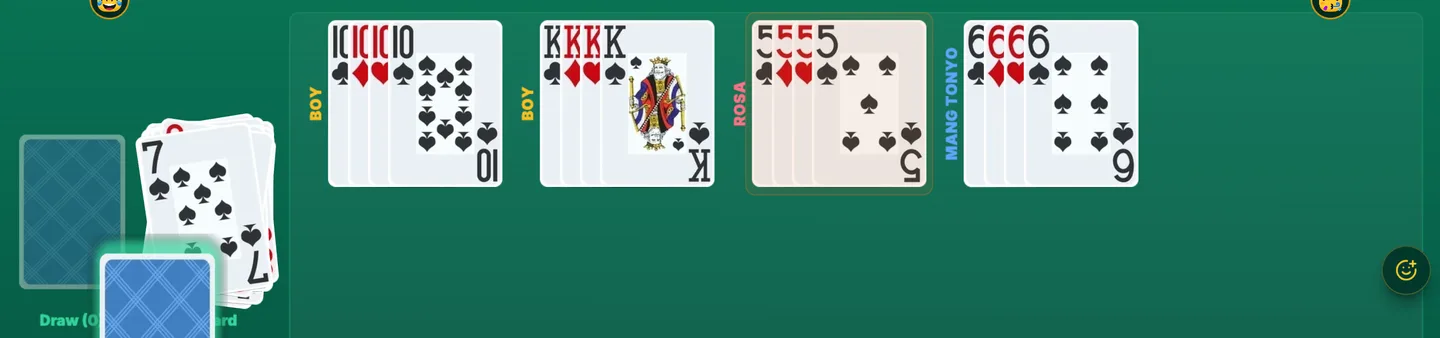
Sapaw means laying a card onto a meld that is already on the table, including melds your opponents exposed. If someone shows three kings and you hold the fourth, that king can leave your hand.
Sapaw is also how you block a Fight, and the timing is the whole trick. Lay a card onto a rival's exposed meld and they cannot call a Fight on their next turn. The block lifts once they finish that turn. A Fight that has already been called cannot be stopped, so the Sapaw has to land before their turn comes around, not after they reach for the button.
4. Discard, and the turn passes
Unless you are going out, you finish by discarding one card. The card you throw is information, so the strongest players are reading discards as much as their own cards.
How a Hand Ends
There are three ways, and they pay differently.
- Tongits. You get rid of every card in your hand. This wins immediately and carries a bonus.
- The deck runs out. Play stops and the lowest deadwood wins.
- A Fight is called. A player who likes their position challenges the table. The others either Challenge, and compare hands, or Fold and concede.
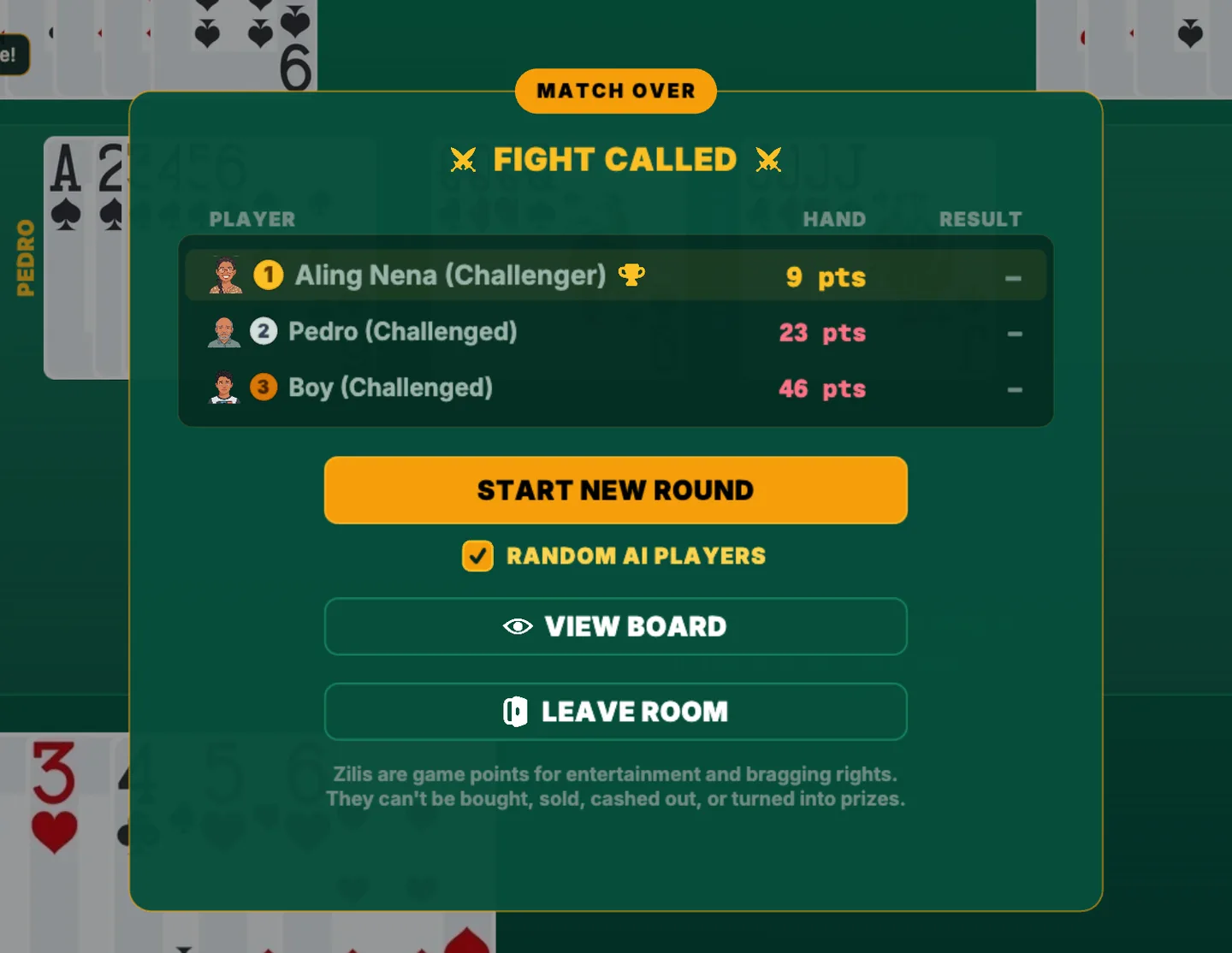
Calling a Fight with a hand that is not actually lowest is the classic way to lose a strong position. Once it is called it is settled, so the discipline is in waiting, and in sapawing anyone who looks ready before their turn arrives.
Where This Project Came From
In 2003, Rico Zuñiga released a free Tongits game with computer opponents, written in C++ and later published as open source under the MIT licence. It was announced on GameDev.net that November, and other people went on to port it to the Amiga, AROS and Haiku.
Its opponents were an expert system: a fixed ladder of hand written rules, still legible in that project's own source comments. Chow, Call or Draw a card. Look for valid sets, then Show them. Try to Sapaw. Dump a card and end the turn. The same verbs the game still uses today. It played a reasonable game and it never learned a thing. Every hand it played, it played exactly the same way.
Closing that gap is the point of Tongits.io. Rico Zuñiga, Paul Gadi and Marc Polican are building opponents that adapt through Reinforcement Learning (RL) instead of following a fixed ladder: an agent that learns which moves actually win by playing, rather than being told in advance. It is built with agentic coding, and on what Rico has taken from two years of practice and a Master of Management in Artificial Intelligence at Queen's University.
Ready to Play
Reading only gets you so far with a card game. The tutorial deals a fixed hand and walks you through exposing a set, taking a Chow, laying a Sapaw and calling a Fight.
Play Tongits Free